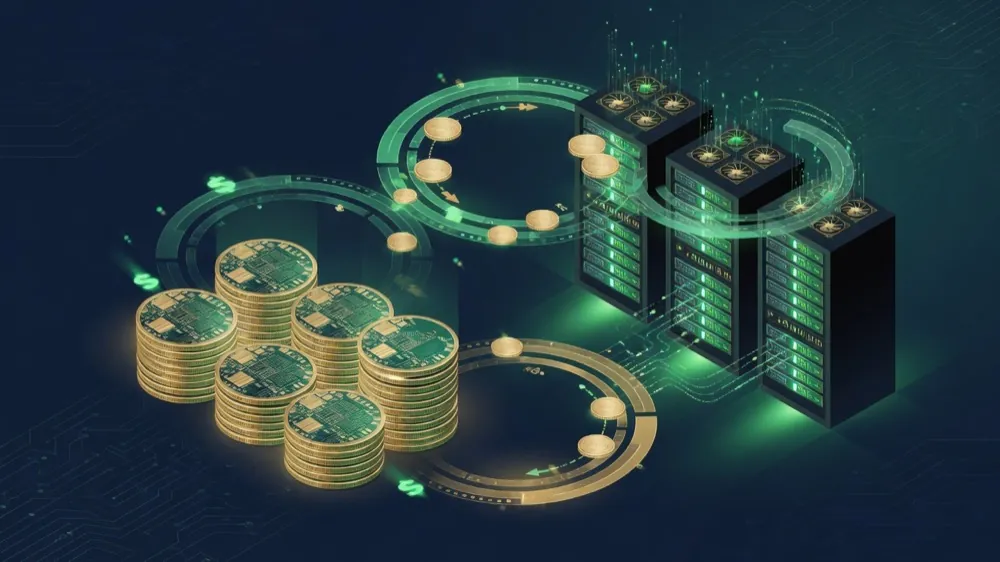
The AI infrastructure buildout is sustained by a capital loop where GPU hardware revenues, cloud capacity reservations, and startup funding rounds cycle directly into one another.
Bloomberg's July 27 report put a clean number on the pattern: a fresh round of AI infrastructure deals that, stacked together, top $750 billion. Late June, the Bank for International Settlements already flagged AI spending and circular financing as a risk to the broader economy. Big tech has gone from propping up growth to putting that growth on a balance sheet loop.
The two pieces of the headline:
- A $500 billion-plus initiative with SK Group (parent of SK Hynix)
- Early talks that could put Nvidia behind OpenAI with as much as a $250 billion lease guarantee on a SoftBank-backed US data center, plus talk of financing about $350 billion in Nvidia chip purchases for the same project
If that sounds abstract, it is not. It is the same merry-go-round ColdFusion dissected in Big Tech is Being Kind of Dodgy At the Moment: money leaves one logo, lands as "demand" at another, and reappears as valuation, revenue, or GDP.
Primary deal reporting: Bloomberg via Yahoo Finance, Nvidia-SK press release, CNBC on the HBM lock-in.
The scale problem: $23T of tech sitting on a data center GDP story
Amazon, Apple, Alphabet, Microsoft, Meta, and Nvidia went from roughly $8 trillion combined market value at the end of 2020 to about $20 trillion by end of 2025, and over $23 trillion now. For years that was "the market is healthy." Conventionally, higher valuations mean better pensions and a richer economy.
Then the composition of growth got weird.
Harvard's Jason Furman (ColdFusion cites the GDP math) noted that in the first half of a recent period, about 92% of the increase in US demand came from just two GDP categories: information processing equipment and software. In plain English: stuff going into data centers. When the same firms that post record valuations also account for most of the measured growth, GDP stops looking like a scoreboard for household prosperity and starts looking like a scoreboard for GPU buildouts.
That is the backdrop for "$750 billion" headlines. The iron is real. The financing is the part that smells.
Deal 1: SK Group's $500B+ is half memory, half systems
The SK piece is public. Letters of intent cover two linked bets:
| Piece | What it is |
|---|---|
| SK Telecom AI factory | Up to 2 GW of Nvidia Vera Rubin on the DSX platform, first factory targeted for 2027 |
| SK Hynix memory | Long-term supply and co-development of next-gen AI memory, including HBM / HBM4 |
Jensen Huang said the half-trillion includes Nvidia buying memory from SK Hynix and SK Group buying Nvidia supercomputers. "Between us, we're going to do half a trillion dollars' worth of business."
This part is not pure vapor. HBM is scarce. Ship GPUs without locked memory and you ship slide decks. The same Friday batch included a $1 billion Nvidia stake in Naver to expand a Korea AI data center (with Brookfield) that runs on Nvidia hardware. Naver jumped more than 8% in Seoul.
Supply-chain insurance and revenue pipeline in one press cycle. Fine. The question is what happens when the same pattern scales into unlisted, unprofitable model labs.
Deal 2: OpenAI talks turn the loop into credit enhancement
The OpenAI path is not signed. Early talks. Terms can die. The structure still matters, because it shows how capacity gets financed when the end customer cannot clear a pure cash-flow bar.
Reported shape (people familiar with the talks):
- SoftBank-linked work on a ~$500 billion, 10 GW hub in Ohio, aimed around 2028
- Nvidia may guarantee up to ~$250 billion so OpenAI can lease that capacity
- Separate talk of financing ~$350 billion of OpenAI's Nvidia chip purchases for the project
A guarantee is not a $250 billion wire. It is a backstop that makes lenders and lessors more comfortable funding a customer that is still burning cash. SoftBank has already committed nearly $65 billion into OpenAI and signed a $40 billion bridge loan for that bet. Nvidia's name on the lease is credit enhancement for SoftBank's tentpole project as much as it is "demand" for GPUs.
Billy Leung at Global X: guaranteeing more of OpenAI's data-center debt deepens vendor financing already under scrutiny. Funding-strain signal as much as demand signal.
Bloomberg also notes Nvidia has already announced more than $540 billion of similar deals this year alone, before counting a potential new OpenAI package.
The circular machine in one diagram (no mysticism)
The critique is mechanical:
- Chip or cloud vendor invests in, finances, or backstops a model lab or neo-cloud
- That customer spends the capital on the vendor's chips, cloud, or capacity
- Vendor books revenue (or "other income"), the lab posts demand, valuations climb, the next raise gets easier
- Repeat until someone outside the loop has to eat the loss: pensions, insurers, public markets, ratepayers
ColdFusion walks the Google-Anthropic version hard. Alphabet pumps tens of billions into Anthropic. Anthropic commits roughly $200 billion of Google Cloud spend over five years. On paper they are rivals. In cash flow they are a closed circuit. Sasha Yanshin's simplified loop: invest $10B, take $10B back as cloud revenue, reinvest at a higher valuation, book another "profit" pulse, repeat until the $200B commitment looks fully funded without ever needing $200B of fresh outside cash in one shot. That is a cartoon of a real pattern, not a court filing. It still fails the sniff test when profits jump while cloud headcount is cut "to reinvest in AI," and the income statement points at other income as a big driver.
Google has also backstopped Anthropic-related data center leases (about a $35 billion loan equivalent in other reporting). Same family of trades: platform vendor, model lab, lease, credit wrapper.
Nvidia's version this week is louder because the numbers are larger and the customer (OpenAI) is still private and unprofitable. Huang has called the circular label "ridiculous" on past deals, saying Nvidia's checks are a small slice of what those companies still raise. That can be true deal-by-deal and still false as a system. Correlated offtake is still correlated risk.
Forensic accountants in the ColdFusion episode (John Wilde lineage, with Kevin Kohaki on the clip) put it in cash-flow English: start with impressive net income, still look fine on headline cash flow, then subtract data-center capex, then stock-based compensation and related buybacks, and free cash flow for the hyperscalers collapses. Five years ago these names were FCF machines. They are spending like infrastructure utilities while markets still price them like software royalty businesses.
The ROI hole the $750B has to climb out of
Here is the line that should sit next to every multi-hundred-billion press release.
A survey of nearly 2,500 companies found that for every $1 spent on AI, only about 18 cents makes it into production. The other 82 cents goes to fixing model errors, reworking output, and operational friction. Any other tool with that hit rate gets cancelled in a quarter. Capital keeps showing up anyway.
Enterprise evidence is not subtle:
- Starbucks spent 2025 hyping an inventory AI for 41,000+ stores, then dropped it after mislabels forced staff to double-check everything
- Duolingo swung hard into AI-generated content, then had to reverse after quality tanked and users pushed back
- Satya Nadella has said LLMs alone are not enough and are unstable without a broader system where humans keep judgment
- Talent firms report companies rehiring judgment after over-firing into an unproven automation wave
Meanwhile Chinese open-weight models closed the quality gap for a huge slice of real workloads, at a fraction of the API cost, runnable offline, with full weight control. ColdFusion flags Cursor, Coinbase, Shopify, Airbnb, Uber Eats, Siemens, and even Microsoft paths shifting toward open and open-weight stacks. If "good enough and cheap" wins for most production use cases, the revenue story that was supposed to pay for trillions of capex gets thinner just as the debt gets thicker.
None of that means AI is fake. Coding and healthcare systems keep improving. It means the LLM layer was mispriced relative to the cost of turning demos into reliable production.
Who sits outside the loop (and still pays)
When private credit, insurers, and pension-adjacent capital fund the iron, retail investors and retirees get exposure without a seat at the term sheet.
ColdFusion highlights the Michael Burry-style chain people keep drawing around Nvidia, intermediate lessors, xAI-class demand, Apollo-style private credit, and Athene-style insurance balance sheets: GPUs sold, leased, booked as revenue, run by a lab, fees collected in the middle, long-duration capital underneath. Whether every link in every diagram is airtight is for auditors and regulators. The incentive is obvious. Fabricated or recycled demand gives exit liquidity to early equity, keeps the IPO and secondary markets hot, and socializes downside into vehicles grandma cannot vote on.
SpaceX's AI-heavy listing story sits in the same neighborhood: file as data processing, claim most of TAM in AI, then buy AI capacity and software companies. The rocket business is real. The equity story is increasingly an AI financing story. If you want that full breakdown, start with ColdFusion's earlier IPO episode and treat this week's Nvidia package as the same movie with a bigger budget.
Nothing here needs to be illegal to be fragile. Circular structures can be GAAP-legal and still systemic.
How to read $750B without getting hypnotized
Treat the number as a multi-year intent pipeline, not cash cleared on one Tuesday.
| Claim | Reality check |
|---|---|
| SK $500B+ | Multi-year memory purchases + system purchases + factory intent. Letters of intent. |
| OpenAI $250B guarantee | Talks. Contingent. Credit enhancement, not a free GPU gift. |
| OpenAI $350B chip financing | Talks. Same early-stage caveats. |
| "$750B" headline | Journalism addition of those paths. Scale signal. Not booked backlog. |
Practical takeaways if you build, buy, or invest around this stack:
- Memory and power still decide who ships. The SK Hynix lock is the part that maps to physical systems, not just financing slides.
- Credit wrappers are product strategy now. Vendor guarantees, capacity prepayments, and "AI factory" joint ventures blur customer and partner on purpose.
- Counterparty risk is part of the architecture. If your cloud bill or model roadmap hangs on one circular graph, you need a money failover, not only a GPU failover.
- Track free cash flow after capex and SBC, not just AI revenue lines. That is where the "still fine" story often dies.
- Watch open-weight substitution. If production work keeps migrating to cheaper models, the utilization math for 10 GW hubs gets ugly fast.
Huang is right that countries like Korea have the industrial base to pour a lot of this concrete and silicon. The harder question is whether end customers can turn that iron into cash flows that service the debt, the leases, and the pension capital underneath.
BIS already called circular AI financing an economy-level risk. Nvidia's $750B week is not a plot twist. It is the plot, in higher resolution.