
Large container images slow down deployments, burn registry storage, and widen your attack surface. If the production image still contains compilers, test runners, and build-time tooling, you are shipping dead weight.
Multi-stage builds fix the packaging side of that problem. You compile in a heavy builder stage, then copy only the runtime artifact into a small final image.
I also measured this against two common alternatives (single-stage and a pre-built deps base) across four ecosystems. The full test suite, Dockerfiles, and raw benchmark numbers live in:
The Problem: Fat Images
A typical Go app needs the compiler, module cache, and system tools to build. A single-stage Dockerfile like this leaves all of that in the final image:
FROM golang:1.23
WORKDIR /app
COPY . .
RUN go build -o main .
CMD ["./main"]
You only need the binary at runtime. The same pattern shows up in Node, Java, and Python: the SDK stays in the image long after the build is done.
Three Build Strategies
The benchmark compares three packaging strategies on the same tiny /health HTTP service per language:
- Single-stage: one image does install, build, and run.
- Pre-built base: deps (and often the SDK) live in a custom base; app builds copy source on top. Final image stays fat.
- Multi-stage: builder stage has the SDK; final stage gets only the artifact (binary,
dist/, JAR, or conda env slice).
Layer order is fixed in every Dockerfile (manifest → deps → source → build) so the comparison is about strategy, not accidental cache wins.
Benchmark Results
Last run in the repo: 2026-07-21, Darwin x86_64, wall-clock averages, uncompressed sizes from docker image inspect. Charts:
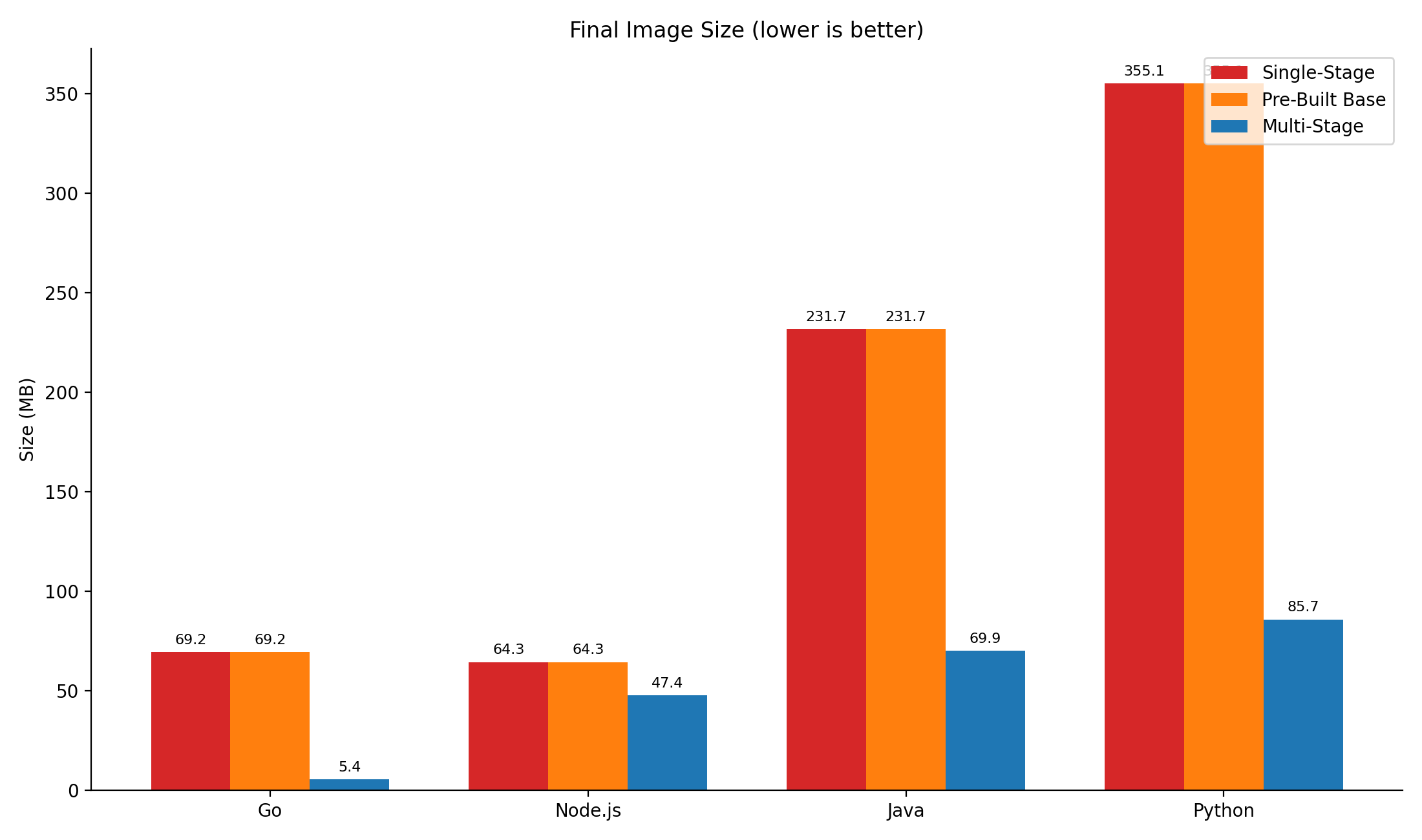
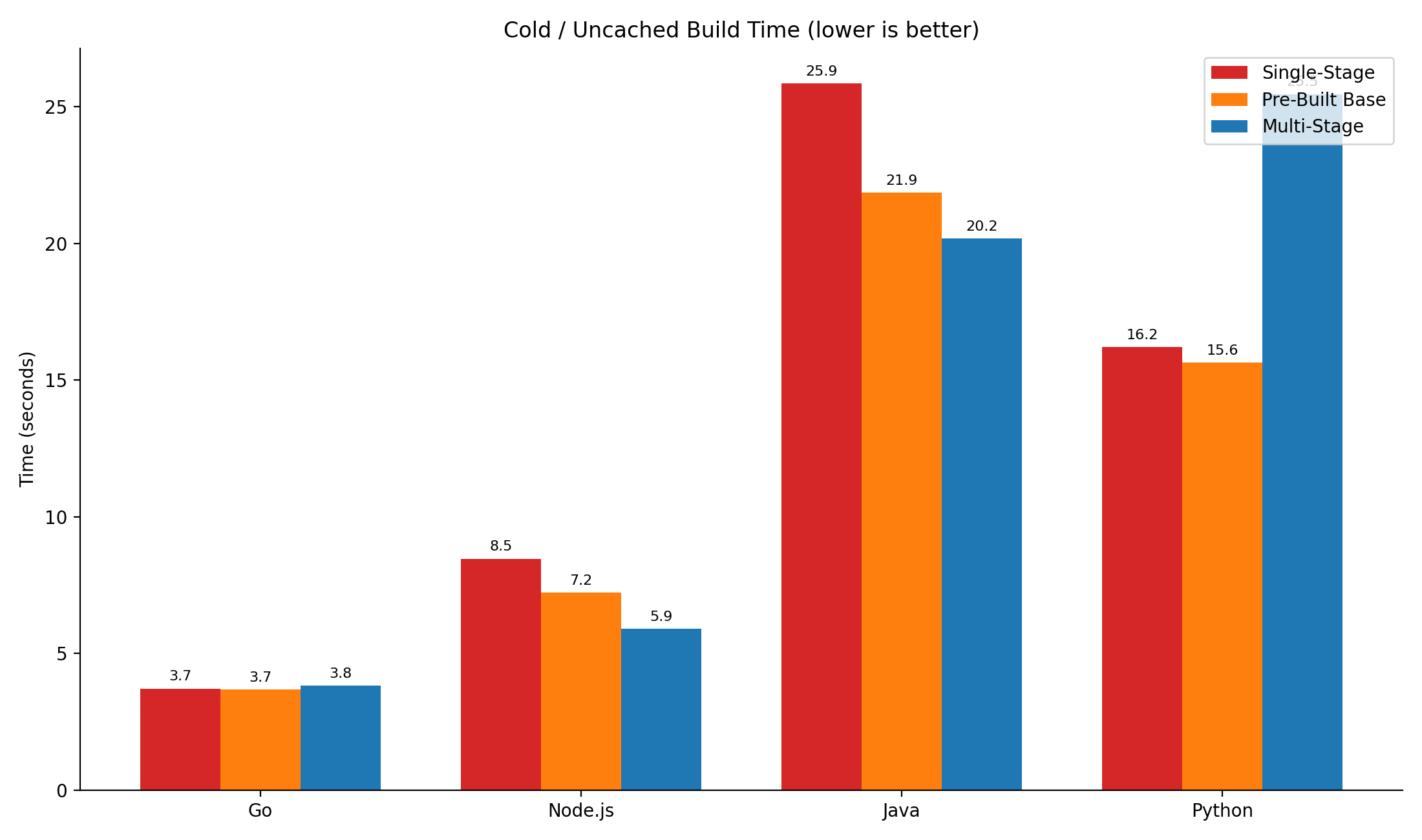
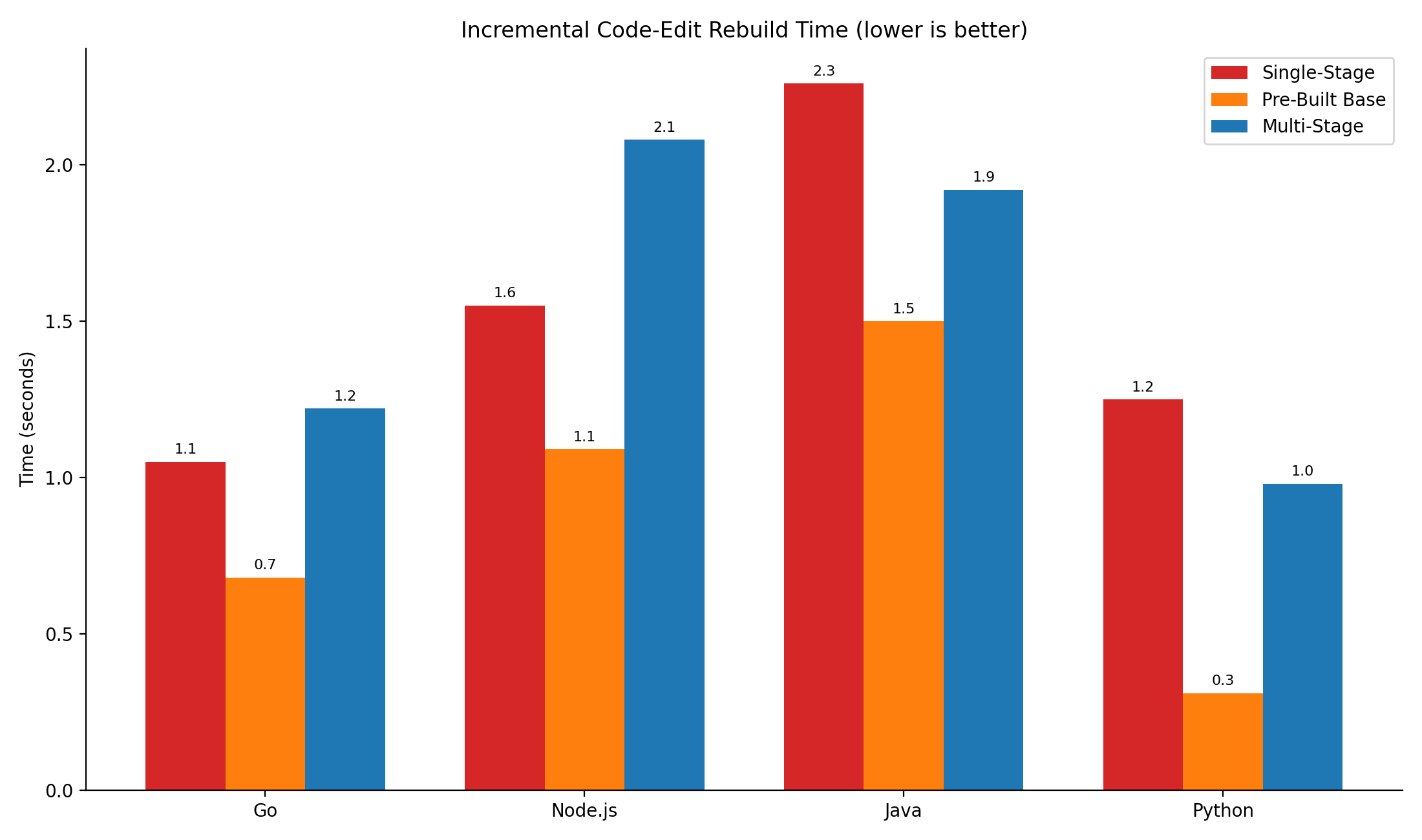
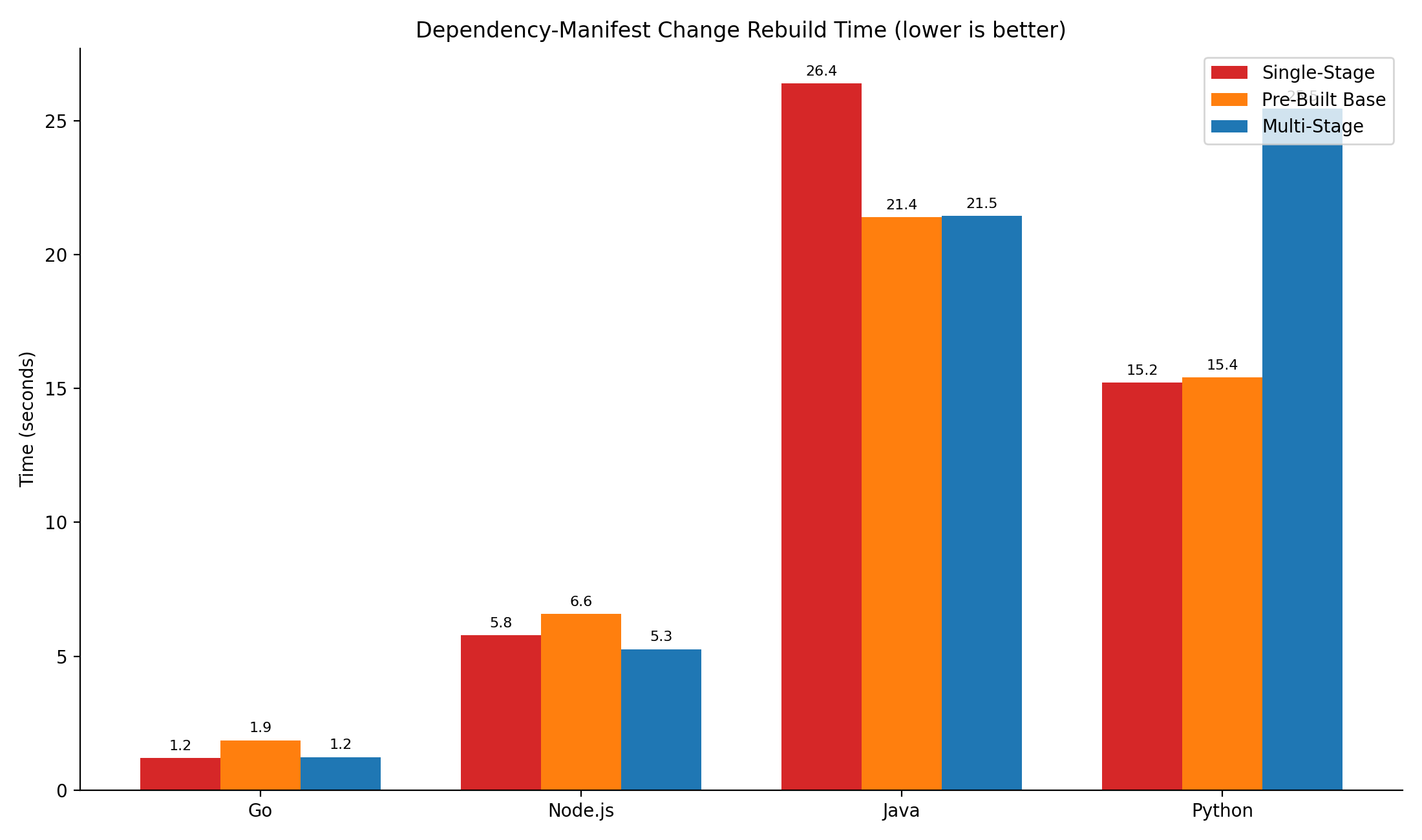
Image size (multi-stage wins)
| Stack | Single-stage | Pre-built | Multi-stage | Drop vs single |
|---|---|---|---|---|
| Go | 69.2 MB | 69.2 MB | 5.4 MB | ~92% |
| Node.js (TypeScript) | 64.3 MB | 64.3 MB | 47.4 MB | ~26% |
| Java (fat JAR) | 231.7 MB | 231.7 MB | 69.9 MB | ~70% |
| Python (Conda) | 355.1 MB | 355.1 MB | 85.7 MB | ~76% |
Across these apps, multi-stage cut final size by about 26% to 92%. Pre-built matches single-stage on size because it still ships the full toolchain on purpose.
Go is the extreme case: you leave a static binary on Alpine/scratch-style runners and drop almost everything else. Node shrinks less because production still needs a Node runtime and prod node_modules. Java and Conda land in the middle: multi-stage drops the JDK/build env or trims the env, but you still ship a real runtime.
Rebuild speed (pre-built wins on pure code edits)
When only application source changes:
| Stack | Single (s) | Pre-built (s) | Multi-stage (s) |
|---|---|---|---|
| Go | 1.05 | 0.68 | 1.22 |
| Node | 1.55 | 1.09 | 2.08 |
| Java | 2.26 | 1.50 | 1.92 |
| Python (Conda) | 1.25 | 0.31 | 0.98 |
Pre-built was fastest on code-edit rebuilds in all four ecosystems. Deps are already in the base, so Docker mostly recompiles app code.
Cold builds and dependency-manifest changes were mixed. Pre-built cold and dep-change times include rebuilding the custom base (fair for a cold CI agent). Multi-stage does not always win wall-clock there, and for Conda cold builds it was slower in this run (~25s multi-stage vs ~16s single).
Smoke tests
Every image for every strategy answered /health successfully. Smaller does not mean broken if the runtime stage is assembled carefully.
Practical takeaway from the data
- Ship multi-stage for production size and attack surface.
- Use a pre-built base when pure code-edit rebuild speed matters most (dev images, some CI paths). Treat it as a convenience image, not the prod runtime.
- Single-stage is a simple baseline. It is rarely best on size, and only sometimes competitive on speed.
Reproduce or extend the numbers:
git clone https://github.com/breejesh/multi-stage-docker-benchmarking.git
cd multi-stage-docker-benchmarking
./benchmark.sh
# or: python3 benchmark.py --apps go node java conda --runs 3
Multi-Stage Dockerfiles
Go
# Stage 1: Build
FROM golang:1.23-alpine AS builder
WORKDIR /app
COPY go.mod go.sum ./
RUN go mod download
COPY . .
RUN CGO_ENABLED=0 GOOS=linux go build -ldflags="-s -w" -o main .
# Stage 2: Runtime
FROM alpine:3.20
RUN apk --no-cache add ca-certificates
WORKDIR /app
COPY /app/main .
CMD ["./main"]
Notes:
- Separate
go mod downloadfromCOPY . .so dependency layers cache when only source changes. -ldflags="-s -w"strips debug symbols.ca-certificateskeeps HTTPS working in the slim image.
Node.js / TypeScript
Node still needs a runtime in production, so multi-stage helps by dropping devDependencies and source:
# Stage 1: Install all dependencies and build
FROM node:20-alpine AS builder
WORKDIR /app
COPY package.json package-lock.json ./
RUN npm ci
COPY . .
RUN npm run build
# Stage 2: Production runtime with only production dependencies
FROM node:20-alpine AS production
WORKDIR /app
COPY package.json package-lock.json ./
RUN npm ci --omit=dev
COPY /app/dist ./dist
CMD ["node", "dist/index.js"]
That is why Node's size win (~26% in the bench) is smaller than Go's (~92%): you still pay for Node + prod modules.
Don't Forget .dockerignore
Multi-stage builds control what ends up in the final image. .dockerignore controls what gets sent to the daemon as build context. Without it, Docker may upload .git/, local node_modules/, test fixtures, and env files on every build.
.git
.gitignore
node_modules
dist
*.md
.env*
.vscode
coverage
__tests__
Dockerfile
docker-compose*.yml
The benchmark apps ignore host artifacts the same way so timings stay comparable.
Security Hardening: Beyond Size Reduction
Fewer packages means fewer CVE paths, but size is not the whole story.
Run as a Non-Root User
FROM alpine:3.20
RUN addgroup -S appgroup && adduser -S appuser -G appgroup
WORKDIR /app
COPY /app/main .
USER appuser
CMD ["./main"]
Use scratch or Distroless Base Images
For static binaries:
# scratch: absolute minimum, no shell, no package manager
FROM scratch
COPY /app/main /main
CMD ["/main"]
# distroless: no shell, but includes CA certs, timezone data, and glibc
FROM gcr.io/distroless/static-debian12
COPY /app/main /main
CMD ["/main"]
| Base Image | Size | Has Shell | Has Package Manager | Best For |
|---|---|---|---|---|
alpine:3.20 |
~7 MB | ✅ | ✅ (apk) |
General-purpose, debugging |
distroless/static |
~2 MB | ❌ | ❌ | Production Go, Rust, C++ |
scratch |
0 MB | ❌ | ❌ | Maximum security, static binaries |
No shell means attackers cannot casually exec into the container and run arbitrary commands.
Production-Ready Dockerfile Pattern
A fuller Go-style pattern: multi-stage build, non-root user, health check, labels, and signal-friendly layout:
# Stage 1: Build
FROM golang:1.23-alpine AS builder
RUN apk --no-cache add ca-certificates
WORKDIR /app
COPY go.mod go.sum ./
RUN go mod download
COPY . .
RUN CGO_ENABLED=0 GOOS=linux go build \
-ldflags="-s -w" \
-o /app/server .
# Stage 2: Production
FROM alpine:3.20
LABEL org.opencontainers.image.source="https://github.com/your-org/your-app"
LABEL org.opencontainers.image.description="Your application description"
RUN apk --no-cache add ca-certificates tzdata \
&& addgroup -S appgroup \
&& adduser -S appuser -G appgroup
WORKDIR /app
COPY /app/server .
USER appuser
HEALTHCHECK \
CMD ["./server", "health"]
EXPOSE 8080
CMD ["./server"]
Why each piece matters:
- OCI Labels tie the image back to source in registries.
tzdatasupports timezone-aware code (time.LoadLocationin Go).HEALTHCHECKlets Docker/Kubernetes restart unhealthy containers.EXPOSEdocuments the intended port for humans and orchestrators.
Bonus: Speed Up Builds with BuildKit Cache Mounts
BuildKit (default since Docker 23.0) can keep package caches across builds even when earlier layers change:
# Cache Go module downloads across builds
RUN \
go mod download
# Cache npm packages across builds
RUN \
npm ci
This helps most in CI, where classic layer caches are often cold. It complements multi-stage packaging; it does not replace it.
The Reality on the Ground
Multi-stage builds are the default I want for production images. The benchmark backs the size story across Go, Node, Java, and Python, with drops from about a quarter to over 90% depending on how much runtime you still need.
They are not free on every axis. Pre-built bases can rebuild pure code changes faster. Cold and dependency rebuilds depend on the ecosystem. Measure your own apps if rebuild latency is the bottleneck.
Stack the basics together: multi-stage for what you ship, .dockerignore for context, non-root (and distroless/scratch when it fits) for security, health checks for ops, BuildKit caches for CI. For the benchmark suite and charts behind this post, see multi-stage-docker-benchmarking.